

Planning Exemption Is Not Retrospective. A Warning for Property Sales

Executive Summary for Conveyancing Professionals
Commencement and Context. The Planning and Development (Exempted Development (Act of 2000)) (No. 3) Regulations 2026 (S.I. No. 340 of 2026) officially came into operation on 27 July 2026. These regulations introduced significant expansions to domestic exemptions, most notably the Class 3A detached garden dwelling.
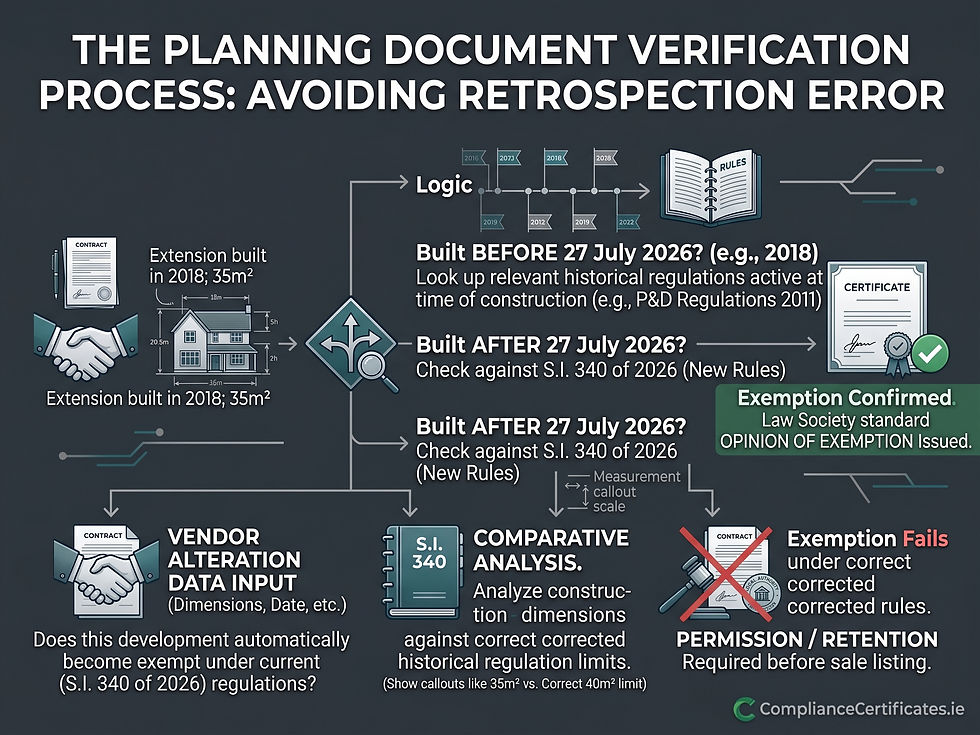
The Retrospective Fallacy. A massive conveyancing risk exists where homeowners believe that because new rules permit a certain development (e.g., a specific dormer or a 45m² extension), any existing identical structure built before 27 July 2026 automatically becomes legal. This is false.
The Rule of Law. In Irish Planning Law, the legality of a structure is determined by the planning regulations active at the exact time the work was constructed.
Risks to Sales. Advertising an older unauthorized structure as "exempt" under the 2026 rules leads to deal collapse, mortgage refusal, requisitions on title, and vendor liability.

Planning Exemption Retrospective Ireland Rules. What Vendors & Agents Must Know
The excitement surrounding the expanded planning exemptions that took effect on 27 July 2026 has been palpable across the Irish property market. However, this optimism has masked a dangerous widespread misconception: the belief that the new, more relaxed regulations (S.I. No. 340 of 2026) effectively regularize any older unauthorized development that would now qualify under the current rules.
This assumption is the single greatest threat to residential conveyancing speed in 2026/2027.
For estate agents and solicitors, this "retrospective fallacy" can destroy trust, collapse sales during final close, and lead to significant professional negligence claims. Planning exemption is not, and never has been, retrospective.
The Legislative Clarity. Commencement and Relevant Periods
The legality of planning exemption is determined by chronology, not current desire. A quick look at the core legislation, provided at the start of this discussion, confirms this principle.
Under S.I. No. 340 of 2026, Article 1(3) explicitly states:
"These Regulations shall come into operation on the 27th day of July 2026."
Furthermore, in the detailed requirements for the main new exemption (Class 3A for detached garden homes), Article 3(2) states:
"This exemption shall apply only to development that is commenced and completed during the relevant period."
(The 'Relevant Period' is defined in Article 3(1) as ending on 31 December 2030).
These clauses make it unequivocally clear that the simplified rules and expanded allowances introduced in July 2026 apply solely to works constructed between July 2026 and December 2030.
Works constructed in 2010, 2018, or 2023 must still meet the specific, stricter, and smaller exemptions that were active in 2010, 2018, or 2023.
THE PRINCIPLE OF CHRONOLOGY | |
Date Work was Constructed | Planning Rule that Determines Legality |
Pre-1 October 1964 | Planning Act of 1963 (Generally Exempt) |
October 1964 – December 2001 | Local Government (P&D) Act 1963 et al. |
January 2002 – 26 July 2026 | P&D Regulations 2001, as amended |
27 July 2026 – 31 Dec 2030 | S.I. 340 of 2026 (New Exemptions) |
4 Main Practical Risks of Retrospective Assumption in Property Sales
When a property goes to market with an older, uncertified structure that is incorrectly described as "exempt" under the new 2026 rules, the sale faces several immediate vectors of failure.
1. Inability to Produce an Architect's Opinion of Exemption
A primary duty for a vendor’s solicitor is to provide a complete contract pack. Requisition Question 35 from the Law Society asks for proof of compliance with planning. If an extension or garden room was built without permission, and does not qualify under the regulations in force at the time, no RIAI-registered architect or chartered engineer will sign a Law Society-approved Opinion of Exemption.
They cannot retrospectively apply 2026 rules to a 2018 build. This means no closing paperwork, leading to an immediate conveyancing stall.
2. Immediate Lender Blockage on Mortgage Drawdown
A purchaser’s solicitor has a legal obligation to the mortgage lender. They must certify that the title is free from planning defects. If a professional survey or title search identifies that an alteration is unauthorized, the purchaser's solicitor cannot allow loan drawdown or contract execution. They must protect the lender’s interest, forcing the sale to be renegotiated or abandoned.

3. Immediate Failure of the Professional Site Audit
When a property goes Sale Agreed, the purchaser will often commission their own professional survey (often a conditions survey) and, crucially, a structural/planning compliance assessment from an architect or surveyor.
This site visit is where assumes crumble. When the purchaser’s architect measures a garden room (Class 3 structure) built in 2020 and finds it contains plumbing (toilet/sink) that exceeds the 25m² limit in force in 2020, they will flag it as unauthorized. The vendor may incorrectly point to the new 30m² limit or the Class 3A allowance, but the architect will correctly advise their client (the purchaser) that these rules only apply post-July 2026.
4. Delayed Sales Due to Mandatory Retention Planning Applications
If an unauthorized structure is discovered mid-sale, the only legal way to regularize it is to submit a Retention Planning Application to the Local Authority. While the structure might now meet the physical criteria of the current rules, the application must be processed formally, including public notices and mandatory timelines.
This introduces a minimum delay of 3 to 6 months to the conveyancing timeline. In chain sales, this frequently leads to the collapse of the entire chain, causing cascading financial loss for multiple parties.
Summary - A Best-Practice Warning Checklist for Solicitors & Agents
The 2026 regulations were designed to facilitate housing supply, but they also significantly widened the legal trap for the uninformed professional.
Action Point | Estate Agent Best Practice | Solicitor Best Practice |
Initial Appraisal | Ask the vendor specifically when any extension, attic, or garden building was constructed. | Query the planning history with the vendor immediately upon engagement for a sale. |
Marketing | Do not advertise a non-compliant structure as a habitable space. (e.g., labeling an unauthorized 2018 attic conversion as a "Bedroom" is misleading and potentially negligent.) | Advise vendors that older works must hold distinct proof of compliance against the correct historical regulation. |
Pre-Listing Check | Ask for the architect's Opinion of Exemption during listing valuation. If one does not exist, encourage them to obtain one immediately. | Do not issue draft contracts containing older uncertified structures without first securing professional technical verification. |
Explaining Risks | Educate vendors that assuming exemption leads to mortgage failure and closing stalls. | Warn vendors that assuming regularization leads to title requisitions and delayed loan drawdown. |
How ComplianceCertificates.ie Secures Your Transaction
At ComplianceCertificates.ie (operated by JEArchitecture, Registered RIAI Architects), we are experts in navigating the chronological complexities of Irish planning history. We prevent conveyancing deals from collapsing due to uncertified older developments.
Our services for solicitors and estate agents across Ireland include:
Opinions of Exemption from Planning Control (fully compliant with Law Society of Ireland requirements).
Opinions of Compliance with Building Regulations.
Retrospective Site Inspections: Our registered architects will inspect older structures and assess them against the specific regulations in force at the time of construction.
Expert Pre-Market Planning Audits: We identify planning irregularities before they become a problem, giving vendors time to remedy them (e.g., via retention permission) prior to a sale.
Need Chronological Verification for an Older Development? Don't Risk Retrospective Assumptions.
Secure your sale today. Ensure all historical structures have a professional Opinion of Exemption.
👉 Book a Professional Retrospective Assessment Today or call our professional team to speak with a registered architect.
Yes, for properties built before 2013, an Opinion of Compliance can be provided by a qualified professional, confirming that the building complies with the relevant planning permissions and building regulations in place at the time of construction.


Comments